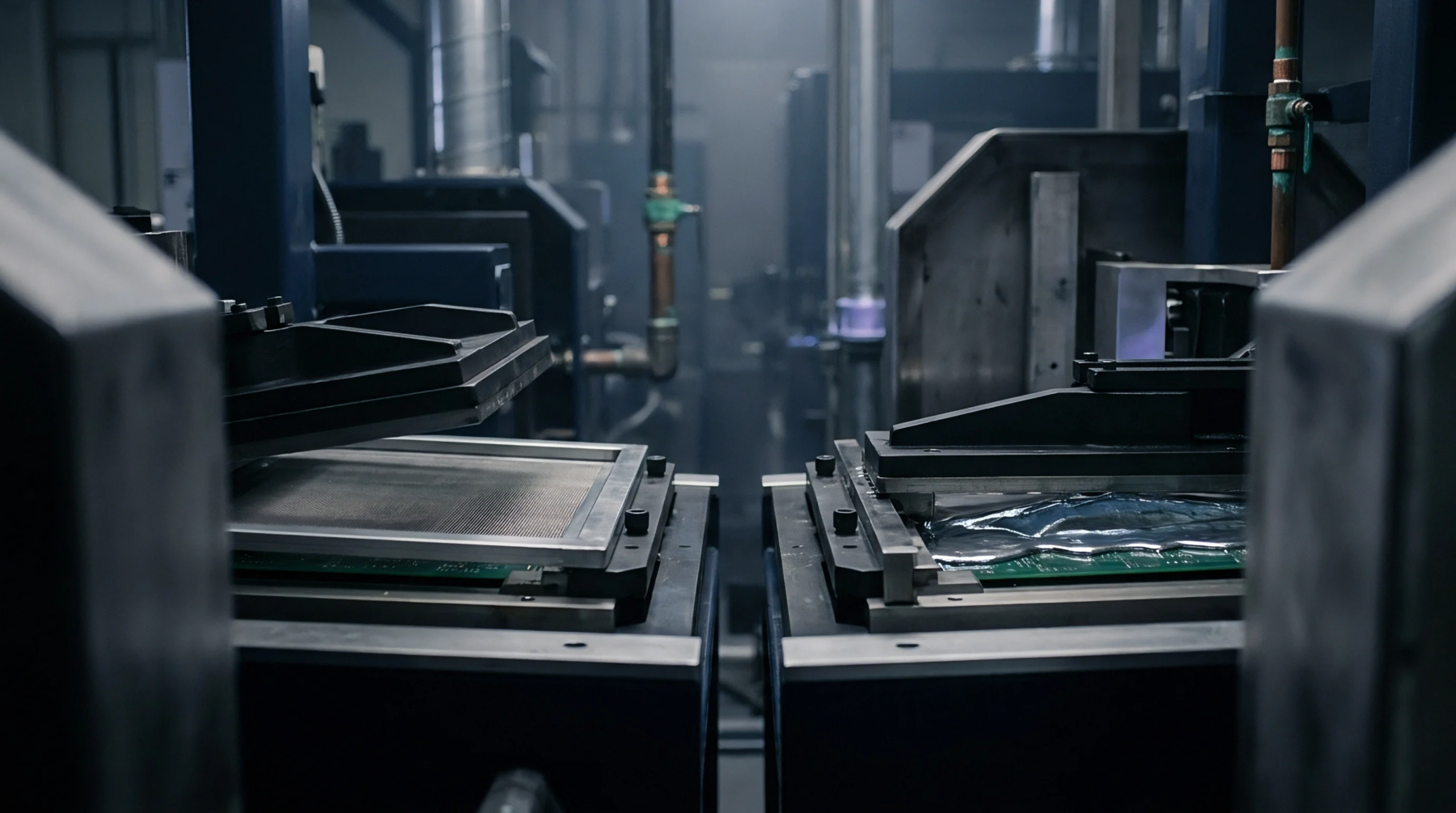
Ultra Smooth Foil Interface Mechanics in Multilayer Board Lamination
Ultra-smooth foil lamination trades mechanical tooth for chemical bonding, demanding tightly controlled press viscosity windows to avoid delamination.
Ultra-smooth foil lamination trades mechanical tooth for chemical bonding, demanding tightly controlled press viscosity windows to avoid delamination.
Asymmetric inner-layer copper weights alter local resin viscosity flow rates during multi-platen pressing, requiring pattern thieving to ensure plane flat panels.

Prepreg resin flow during vacuum lamination requires balancing platen ramp rates against copper fill volume to eliminate internal clearance microvoids.

Analytical squeeze flow models predict trace swim by calculating hydrodynamic drag and side-wall pressure differentials across fine copper features during lamination.

Silica-filled resin viscosity minimization requires synchronizing heating ramps with press pressure timing to ensure complete void encapsulation without core shift.

Dynamic lamination rheology control via 2.0-2.8°C/min platen ramp rates minimizes glass bundle tilt and resin squeeze-out to hold sub-picosecond phase skew.

Multilayer PCB lamination relies on managing dynamic resin viscosity and glass fabric permeability to fill copper features without starving dielectric layers.
Expertise is a utility, not a secret. sentiention™ publishes its working knowledge as open reference: intelligence layer covering the materials it sources, the markets it enters, and the reference that serves both.