Contractual Yield Allowances in Surface Mount Device Assembly Operations
Contractual yield allowances isolate mechanical feeder scrap from reflow defects to protect consigned stock value and settle component variances accurately.

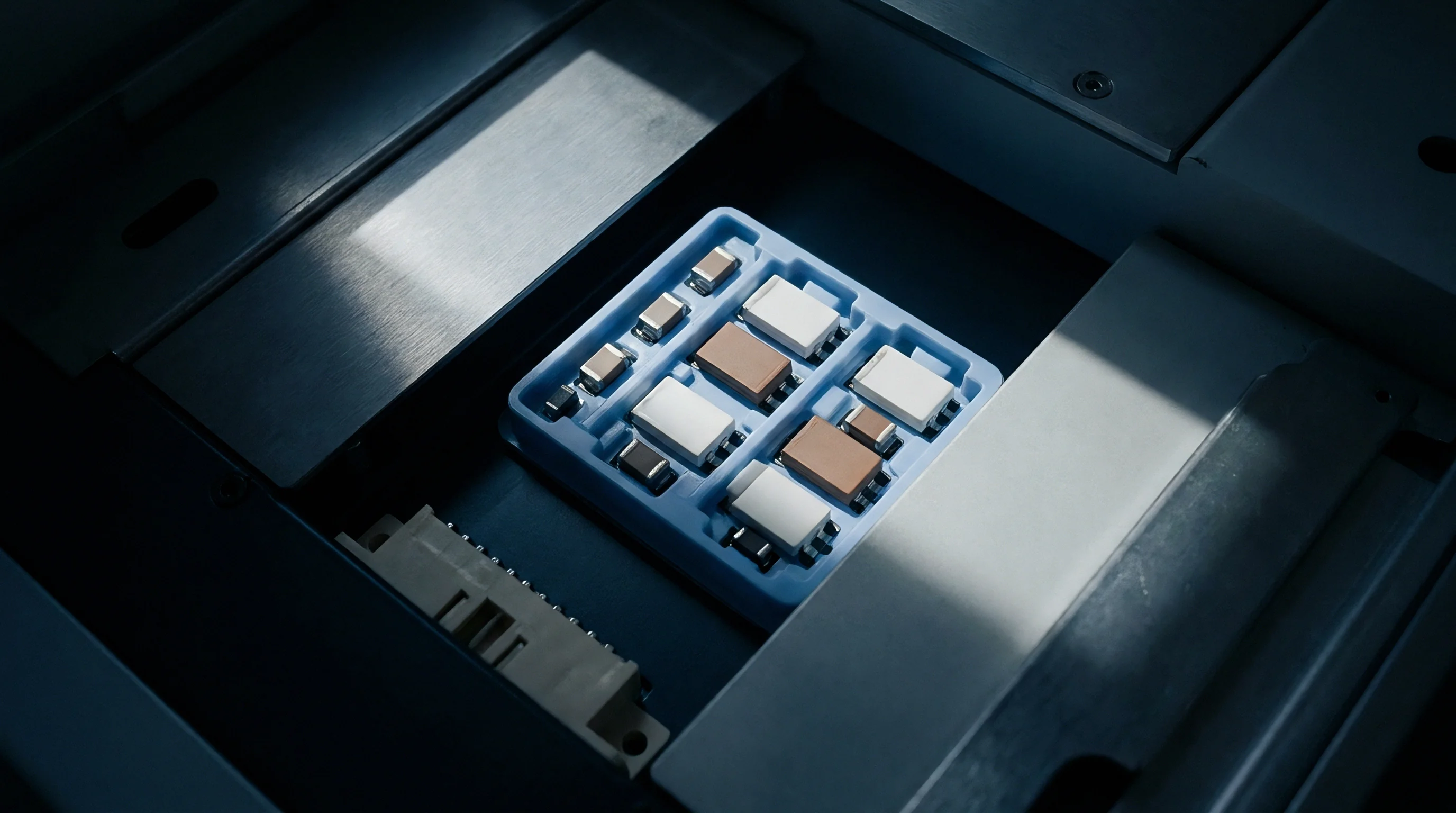
Attrition
Mechanical line setup and automated component placement generate inherent material losses during surface mount assembly runs. Machine vision alignment failures, vacuum nozzle drops, tape pitch indexing tolerances, and manual feeder setup consume raw stock before solder reflow occurs. High-speed placement heads operating under IPC-9850 conditions achieve high theoretical speeds, yet mechanical pick errors scale with small package geometries such as 0201 and 01005 passives.
Understanding these physical loss channels allows buyers to distinguish standard mechanical scrap from operational negligence.
Leader tape requirements form the first physical absorption point for surface mount components. Automated tape feeders require an empty leader section of carrier tape, typically 200 mm to 400 mm in length, to thread through the indexing sprocket and tension mechanism. When components arrive on cut tape strips rather than complete spools, this leader length translates directly into unpickable parts.
Vacuum nozzles missing the component center of gravity during feeder indexing cause the machine vision system to reject parts into an internal trash box. Nozzle wear drops fine pitch parts. Machine recalibration, optical lens contamination, and incorrect feeder pitch settings compound these losses across high-volume production shifts.
Cut tape sections waste components. Manual loading increases scrap risks. Setup scrap occurs early.
The distinction between setup loss and run rate attrition governs how material requirements planning algorithms calculate gross component demand.
- Feeder leader loading waste accounts for the physical components positioned inside the initial tape length required to engage the feeder drive gear before the pick point aligns with the nozzle path.
- Pneumatic pickup reject scrap occurs when vacuum sensors register insufficient suction or optical sensors detect axial tilt exceeding programmed placement tolerances.
- Continuous splice tape misalignment ejects consecutive component pockets when joint tape passes through the feeder window without proper index hole registration.
- Purge reel attrition results from clearing placement head nozzles during batch changeovers or clearing line stoppages following vision system false alarms.
Component tape pitch settings dictate feeder index length. Pocket depth tolerances in plastic embossed tape allow light components to flip or tilt prior to pickup. When parts rotate inside carrier pockets, the automated vision system rejects the part or the nozzle attempts placement on edge, resulting in immediate board-level defects.
Line operators frequently adjust tape tension manually, but inconsistent mechanical pull forces create index drift that multiplies scrap counts over a multi-hour run.
Assemblers frequently attribute unlocated component deficits to carrier tape pockets that arrived empty from the primary distributor.

Reel
Continuous carrier tape packaging dictates component feed dynamics and sets minimum physical scrap volumes per production setup. Full factory spools carrying 4,000 to 10,000 units operate with predictable feed friction, whereas short reels and cut tape sections induce irregular mechanical resistance. Small component packages require specialized feeder friction controls to prevent micro-passives from jumping out of exposed pockets once the top cover tape peels back.
Tape carrier material directly influences pickup reliability. Punched paper tape housing 0402 and 0201 passives generates paper dust during high-speed indexing. This particulate matter accumulates inside vacuum nozzle tips, reducing suction force and increasing drop rates over standard eight-hour production shifts.
Embossed plastic tape used for active components, quad flat no-lead devices, and ball grid arrays provides deeper mechanical pockets but exhibits static electricity buildup if surface resistivity exceeds 1011 ohms per square meter. Anti-static cover tape peeling forces must remain within 0.1 to 0.7 newtons to prevent component chatter during feeder indexing.
| Package Family | Physical Tape Type | Consigned Overage (%) | Consigned Min (Pcs) | Turnkey Target Yield (%) |
|---|---|---|---|---|
| 01005 / 0201 Passives | Punched Paper 8mm | 5.0% | 100 | 99.0% |
| 0402 / 0603 Passives | Punched Paper 8mm | 3.0% | 50 | 99.5% |
| 0805 / 1206 Passives | Paper / Plastic 8mm | 2.0% | 20 | 99.7% |
| SOIC / SOT / DPAK | Embossed Plastic 12-16mm | 1.5% | 10 | 99.8% |
| QFN / QFP / BGA | Embossed Plastic / Tray | 0.5% | 2 | 99.9% |
Smaller passive packaging requires higher percentage overages to compensate for feeder loading length losses.
Component footprint dimensions establish the absolute overage baseline. Large active devices packed in matrix trays present near-zero feeder setup scrap, as pick heads access components directly from static grid locations. Passive components delivered on partial spools demand continuous overage adjustments because cut tape edges lack factory leader lengths.
Buying short-strip components on the open market lowers unit purchase prices while simultaneously elevating assembly line scrap percentages.
High-density passive components packaged in paper tape demand continuous operator vigilance during splicing to prevent feeder index jams.


Defect
Solder joint acceptance standards establish the boundary between physical placement loss and assembly workmanship rejects. Defective assemblies identified at automated optical inspection or three-dimensional X-ray inspection represent process scrap rather than feeder attrition. Attributing post-reflow solder bridges, tombstoning, or component de-wetting to standard component loss distorts line efficiency metrics and misallocates financially material costs.
IPC-A-610 defines visual acceptance criteria across three product classes, establishing strict limits for solder fillet dimensions, component misalignment, and voiding percentages in surface mount solder joints. Class 2 industrial electronics permit component overhang up to 50 percent of termination width, whereas Class 3 high-reliability applications restrict overhang to 25 percent and mandate higher minimum wetting heights. When a board fails Class 3 inspection due to profile imbalance or paste stencil release variation, the component undergoes manual hot-air desoldering.
Thermal cycles imposed by rework degrade PCB laminate resin and adjacent joint integrity, capping allowable rework passes per location.
| IPC Class | Baseline First-Pass Yield Target | Allowable Rework Cycles | Max Voiding (BGA Joint) | Scrap Financial Liability Holder |
|---|---|---|---|---|
| Class 1 General | 95.0% | 3 Passes | 30% Area | Assembler absorbs excess over 3% |
| Class 2 Industrial | 98.0% | 2 Passes | 25% Area | Assembler absorbs excess over 1% |
| Class 3 High-Rel | 99.2% | 1 Pass | 15% Area | Assembler absorbs all process scrap |
Process scrap differs fundamentally from feeder pickup loss. Feeder drops leave pristine components inside the machine scrap tray, preserving component re-usability if static integrity holds. Reflow defects destroy both the board area and the component lead metallurgy through intermetallic compound formation.
Consigned stock suffers first. Rework caps at two passes. Attribution shifts to assembly.

Which Allowance Method Protects Consigned Stock?
Contract agreements isolate component attrition from assembly line process yields by assigning distinct percentage thresholds to each operational phase. Component attrition applies exclusively to unplaced parts lost between reel loading and placement nozzle release. Process yield measures the proportion of correctly assembled, reflowed, and inspected boards passing initial functional test without requiring manual intervention.
Contracts referencing IPC-A-610 Class 3 standards shift rework cost liabilities to the assembler when visual joint criteria fail after reflow.
Merging process defects with component feeder loss allows contract electronics manufacturers to mask poor stencil printing or incorrect thermal profiles behind blanket component scrappage limits. A well-constructed master service contract maintains separate ledgers for feeder setup losses and post-reflow visual defect rates.
Section 4.2 of the standard assembly agreement limits allowable process scrap to one half of one percent, compelling the factory to cover component replacement costs beyond that threshold.

Clause
Master service agreements define the financial risk allocation between original equipment manufacturers and contract electronics manufacturers. Specific scrap allowance clauses dictate whether component losses fall under consigned stock rules or turnkey bill-of-materials pricing. Without explicit value tiers and threshold definitions, buyers absorb the financial impact of lost high-value active components under blanket percentage clauses written for low-cost passive chips.
Contract language must distinguish between volume-based percentage scrap allowances and absolute component minimums. A three percent scrap allowance on a run of 1,000 boards permits the assembler to lose 30 units of every component item. For a 0402 resistor costing $0.002, this loss equals six cents.
For an application-specific integrated circuit costing $85.00, losing 30 units creates a $2,550.00 financial unbalance. High-value component thresholds enforce a dollar cap, typically set between $10.00 and $50.00, above which standard percentage scrap allowances become invalid.
Active components exceeding fifty dollars per unit carry a zero percent yield allowance requirement across all signed purchase orders.
Establishing clear audit protocols prior to releasing consigned stock protects both parties from post-production material disputes. Line-side inventory verification verifies total quantities, tape continuity, and reel integrity before components enter the manufacturing floor.
- Verify total package count and distributor lot codes against the consigned bill of materials shipping manifest upon physical dock arrival.
- Inspect carrier tape integrity, checking for damaged sprocket holes, split cover tape, or missing components in carrier pockets.
- Log factory reel seal dates and moisture sensitivity levels in accordance with IPC/JEDEC J-STD-033 handling requirements.
- Issue a signed material receipt confirmation documenting actual unit counts, cut tape lengths, and existing leader deficits.
- Transfer accepted stock to the line kit area under controlled electrostatic discharge conditions conforming to ANSI/ESD S20.20.
Turnkey assembly quotes incorporate component scrap expenses directly into unit placement fees. Contract manufacturers calculate an internal scrap multiplier based on historic shop floor drop rates, building this cost buffer into the quoted bill-of-materials price. Consigned projects strip this buffer away, leaving the buyer directly exposed to material shortages if the factory exceeds standard feeder loss boundaries without financial penalty mechanisms.
Spot price spikes create exposure. Blanket yield allowances conceal operational line inefficiencies. Uncapped scrappage terms shift primary material risks onto the buyer.
Failing to exempt active integrated circuits from general scrappage allowances forces the buyer to pay for replacement silicon at spot market price spikes.

Ledger
Financial reconciliation of component stock requires a structured line-by-line accounting of issued quantities against completed assembly output. The material ledger tracks every part from receiving entry through placement, reflow inspection, scrap bin audit, and final return inventory. Discrepancies between calculated theoretical material usage and actual physical inventory balances trigger financial adjustments at batch closeout.
To demonstrate the mathematical framework governing material reconciliation, assume a production run of 2,000 double-sided surface mount assemblies. The bill of materials specifies three representative component categories: a 0201 thick-film ceramic capacitor, a 64-pin quad flat no-lead microcontroller, and a high-density ball grid array memory IC. The contractual agreement defines a 3.0% yield allowance for passives with a 50-piece minimum, a 0.5% allowance for the QFN with a 2-piece minimum, and a 0.0% allowance for the BGA IC.
The buyer consigns all materials in full factory reels or original tray packaging.
| Line Item | Unit Cost | BOM Qty / Board | Total Required | Quantity Consigned | Allowed Scrap | Actual Scrap | Net Variance | Financial Settlement |
|---|---|---|---|---|---|---|---|---|
| 0201 Capacitor | $0.003 | 20 | 40,000 | 41,500 | 1,200 | 1,450 | +250 Pcs | Assembler owes $0.75 |
| QFN Microcontroller | $12.50 | 1 | 2,000 | 2,020 | 10 | 6 | -4 Pcs | Return 14 Pcs to Buyer |
| BGA Memory IC | $68.00 | 1 | 2,000 | 2,005 | 0 | 2 | +2 Pcs | Assembler owes $136.00 |
The calculation sequence evaluates line-item material movement through four sequential equations:
First, theoretical consumption calculates gross component demand based on passed board count:
Theoretical Consumption = Passed Boards x BOM Quantity Per Board
Second, allowable scrap establishes the maximum component loss absorbed by the buyer:
Allowable Scrap = Maximum(Theoretical Consumption x Contract Scrap Percentage, Minimum Piece Overage)
Third, actual component loss isolates physical line scrap against returned physical inventory:
Actual Scrap = Consigned Quantity – Theoretical Consumption – Unused Physical Inventory Returned
Fourth, net variance isolates billable component deficits exceeding contractual allowances:
Billable Variance = Maximum(0, Actual Scrap – Allowable Scrap)
Unopened full reels returned at project completion eliminate artificial material shortage invoices.
Applying these calculations to the 0201 capacitor line item yields a theoretical consumption of 40,000 pieces. The contractual 3.0% allowance computes to 1,200 pieces, exceeding the 50-piece minimum constraint. Line tear-down reveals 1,450 parts lost across feeder setups, nozzle drops, and splice purges, leaving 5,000 unused units on the spool.
The actual scrap of 1,450 parts exceeds the allowed scrap threshold of 1,200 parts by 250 units. Multiplying this 250-unit excess by the $0.003 unit cost generates a minor $0.75 charge payable by the assembler.
Evaluating the BGA memory IC line item demonstrates the financial impact of high-value zero-allowance terms. Theoretical consumption equals 2,000 units across the completed batch. The contractual scrap allowance is explicitly zero percent.
Floor audits account for 2,003 physical units: 2,000 mounted on passed boards, 3 pristine units remaining in the original matrix tray, and 2 units destroyed during line setup. The actual scrap equals 2 units. Because allowable scrap is zero, the billable variance equals 2 units.
At $68.00 per unit, the contract manufacturer incurs a direct $136.00 charge payable to the buyer or credited against assembly labor charges.
For the QFN microcontroller, theoretical consumption reaches 2,000 units. The allowed scrap threshold of 0.5% permits 10 units of loss. Actual line loss totals 6 units, leaving 14 unconsumed components in the original tape strip.
The actual scrap falls below the contractual threshold. The assembler returns all 14 unmounted components to the buyer without financial penalty or scrappage charges.

Recovery
Post-production auditing closes the physical material loop by verifying scrap bin inventories and unhandled component spools. Collecting unused consigned inventory immediately upon production closeout prevents component loss, degradation from unmonitored atmospheric exposure, or unauthorized absorption into general shop floor stock. Systematic reconciliation ensures that unmounted high-value parts return to the buyer’s controlled inventory.
Feeder strip teardowns yield partial tape sections, loose components in collection channels, and sealed spools. Factory operators must return cut tape segments exceeding 50 mm in length to the original packaging, recording residual counts through manual pitch calculations or optical wheel counters. Vacuum trash boxes attached to pick-and-place machines contain dropped passives mixed with ambient shop debris.
While bulk passives retrieved from drop boxes are discarded due to electrostatic risk and potential lead oxidation, active components housed in matrix trays undergo visual lead inspection and vacuum baking before return.
- Unused full spool return requires original distributor label retention, intact moisture barrier packaging checks, and floor-life status logging per J-STD-033.
- Partial tape counting verification utilizes optical tape counter instruments to confirm remaining unit quantities before updating enterprise resource planning inventory records.
- Traced component scrap auditing involves matching physical drop box counts against automated machine error logs to confirm specific pick failure rates.
- Financial credit note issuance converts verified component overages and assembler-absorbed scrap liabilities into direct deductions against final assembly invoices.
Pockets bind during indexing. Lead tape consumes component positions. Micro-switches register missing components.
Excess parts remain property.
The industry continues to debate whether automated optical inspection false-call data should serve as binding evidence when settling micro-passive drop rate disputes between buyers and contract manufacturers.